Regeneration and fatigue
H₂ inhalation may be considered by people experiencing an increased burden on the body, fatigue, or a need for additional support of regenerative processes.

Therapies · Regeneration
A modern, non-invasive method supporting the body in processes related to oxidative stress and regeneration.
At Centrum Zdrowia Biomed in Gdańsk we offer hydrogen therapy in the form of a comfortable molecular hydrogen (H₂) inhalation.
During a 60-minute session, hydrogen is delivered through a small nasal cannula. There is no need to perform any special breathing exercises – you simply sit or lie down comfortably, breathe naturally and rest.
60 minutes per session
non-invasive inhalation
comfortable conditions
Brief answer
Hydrogen therapy involves delivering molecular hydrogen (H₂) to the body. Inhalation is one of the ways of administering it.
H₂ is a very small molecule, and its properties together with its ability to cross biological barriers have made it the subject of experimental and clinical research.
Current research focuses, among other things, on its potential effect on mechanisms related to oxidative stress, the inflammatory response and cell protection.
Studies involving humans have already been described in the scientific literature, but hydrogen therapy remains a developing area of research and should not be presented as a method of treating specific diseases.
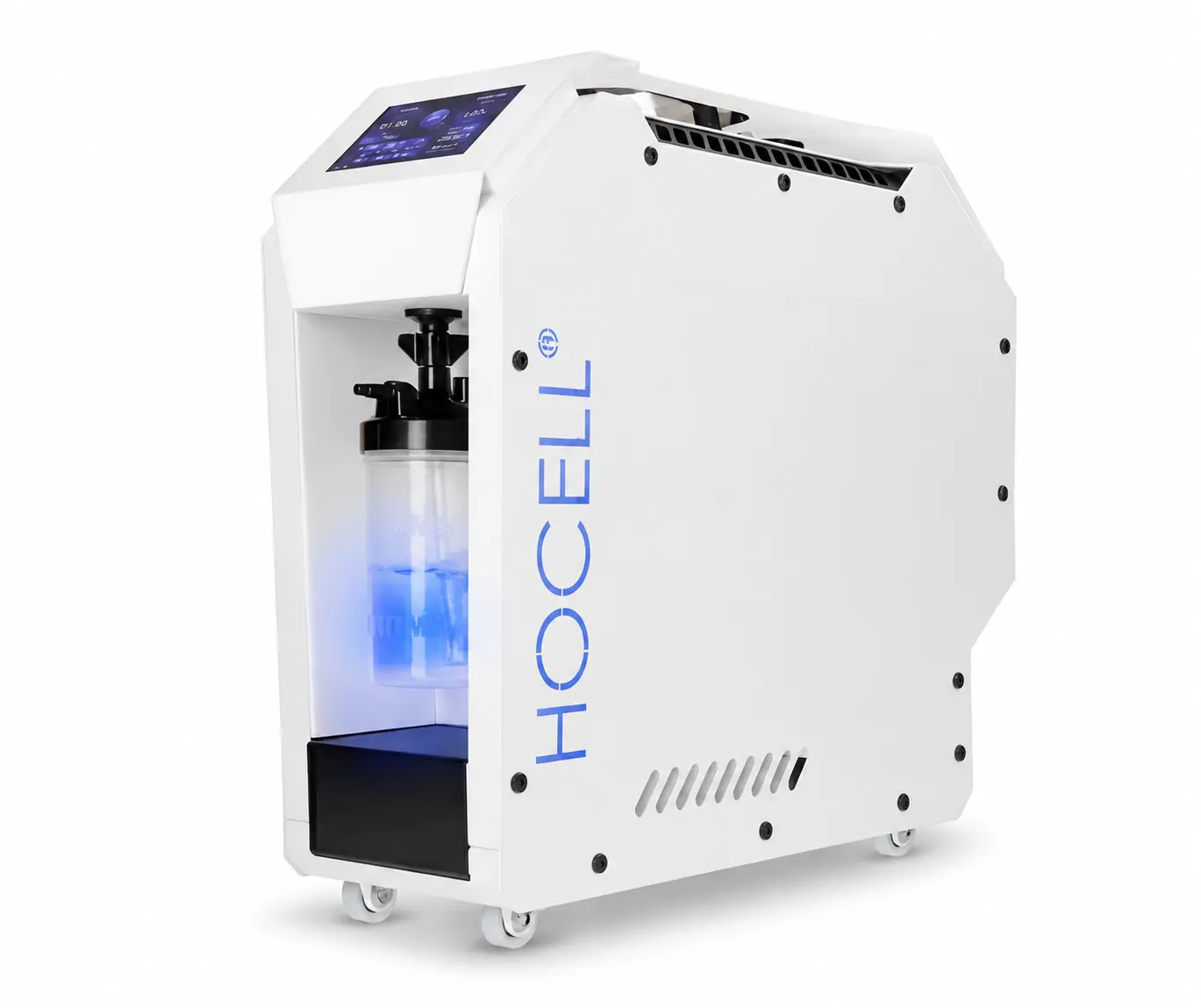
During the inhalation you do not have to do anything extra. You sit down comfortably, put on the nasal cannula and breathe naturally for 60 minutes.
It is time you can spend resting, reading, listening to music, or simply having a moment for yourself.
/Applications
Hydrogen therapy may be considered as a method of supporting the body, especially during periods of increased burden and a need for regeneration. The use of molecular hydrogen is currently being analysed in many areas of scientific research.
H₂ inhalation may be considered by people experiencing an increased burden on the body, fatigue, or a need for additional support of regenerative processes.
Molecular hydrogen is also studied in the context of physical exertion, oxidative stress and the processes that take place during post-exercise recovery.
This is one of the most important directions of research into H₂.
Researchers analyse the potential effect of hydrogen on the balance between reactive oxygen species and the body's natural protective mechanisms.
A small randomised study from 2024 observed a reduction in the measured ROS level after H₂ inhalation, but such results require further confirmation in larger studies.
In certain situations, hydrogen therapy may be considered as an additional element supporting the body during a return to activity.
It does not, however, replace rehabilitation or treatment prescribed by a doctor.
H₂ is the subject of research concerning processes related to oxidative stress, cell function and the changes that occur with age.
Research into hydrogen also covers various areas of medicine and chronic conditions.
In such cases, H₂ inhalation may be considered exclusively as a complementary method and does not replace diagnostics, pharmacotherapy or treatment led by a doctor.
/Mechanism
The mechanism of action of hydrogen is more complex than the popular phrase “neutralising free radicals”.
Contemporary research analyses H₂ in terms of, among other things, its influence on oxidation-reduction balance, cell signalling processes and the inflammatory response.
At the same time, the available results do not justify presenting H₂ as a universal therapeutic agent.

/Research
Research into molecular hydrogen covers laboratory experiments, animal studies and clinical studies involving humans.
The authors point to interesting results, but at the same time emphasise the need for further clinical studies.
See scientific publications →A literature review published in 2023 identified:
64
publications concerning studies in humans
81
registered clinical trials
/Procedure
An interview is carried out before the inhalation begins.
It allows us to understand the purpose of the visit and to assess whether hydrogen therapy can be used.
You take a comfortable seated or semi-reclined position.
A small nasal cannula is then fitted, through which the gas is delivered during the session.
There is no need to control your breathing or perform any special exercises. Breathing naturally is enough.
Hydrogen is a colourless and odourless gas, and the inhalation is non-invasive.
During the session you can rest, read a book, listen to music or use your phone.
The inhalation does not normally require a recovery period.
After the session you can return to your everyday activities, unless you receive different individual recommendations.
/Together
60 minutes you can spend resting together
You do not have to come for the inhalation on your own.
At Centrum Zdrowia Biomed we have two hydrogen therapy stations, which means we can run two inhalations at the same time.
You can come with your partner, a friend, a family member or another close person and spend that time resting together.
Book an inhalation for two →
/Price list
Single
1 session
60 minutes
80 zł
Ideal for trying the inhalation
Package
5 sessions
5 × 60 minutes
350 zł
70 zł / session
You save 50 zł
Package validity: 2 months
Best value
Package
10 sessions
10 × 60 minutes
640 zł
64 zł / session
You save 160 zł
Package validity: 4 months
Packages are personal and non-transferable. Unused sessions do not expire within the package validity period.
No. The inhalation is a non-invasive method. The gas is delivered through a small nasal cannula and you breathe naturally throughout the session.
No. Hydrogen is a colourless and odourless gas.
You can simply rest.
During the session you sit or lie comfortably and breathe naturally through the nasal cannula.
You can read, listen to music or use your phone.
A single session at Centrum Zdrowia Biomed lasts 60 minutes.
There is no single number of sessions that suits everyone.
The number and frequency of inhalations depend, among other things, on the purpose for which they are used and on your individual situation.
Clinical studies have assessed the tolerability of inhaled H₂.
For example, in a phase I study involving eight healthy adults, exposure to 2.4% H₂ for 24–72 hours produced no clinically significant adverse events related to the inhalation.
This was, however, a small study and its authors pointed to the need for further safety evaluation.
The inhalation does not normally require a recovery period.
After the session you can return to your everyday activities, provided that individual recommendations do not state otherwise.
No.
Hydrogen therapy does not replace diagnostics, medication, rehabilitation or any other treatment methods prescribed by a doctor.
In the case of health problems it may be considered exclusively as a complementary method.
Yes. Centrum Zdrowia Biomed has two stations, so two people can use the inhalation at the same time.
Centrum Zdrowia Biomed
Would you like to learn more about hydrogen therapy or book your first session? Get in touch with Centrum Zdrowia Biomed in Gdańsk.
We will answer your questions about how the inhalation works and help you choose a convenient date.
Centrum Zdrowia Biomed ul. Rajska 14/Disclaimer
The content published on this page is informational and educational in nature and does not constitute individual medical advice.
Hydrogen therapy is a developing area of scientific research.
It does not replace diagnostics, pharmacotherapy, rehabilitation or treatment led by a doctor.
In the case of chronic conditions, taking medication, pregnancy or other health problems, the possibility of using the inhalation should be consulted with an appropriate specialist.
Related therapies
Next step
Let's talk about symptoms, questions, and health goals. Together we will choose the right diagnostics or therapy.